

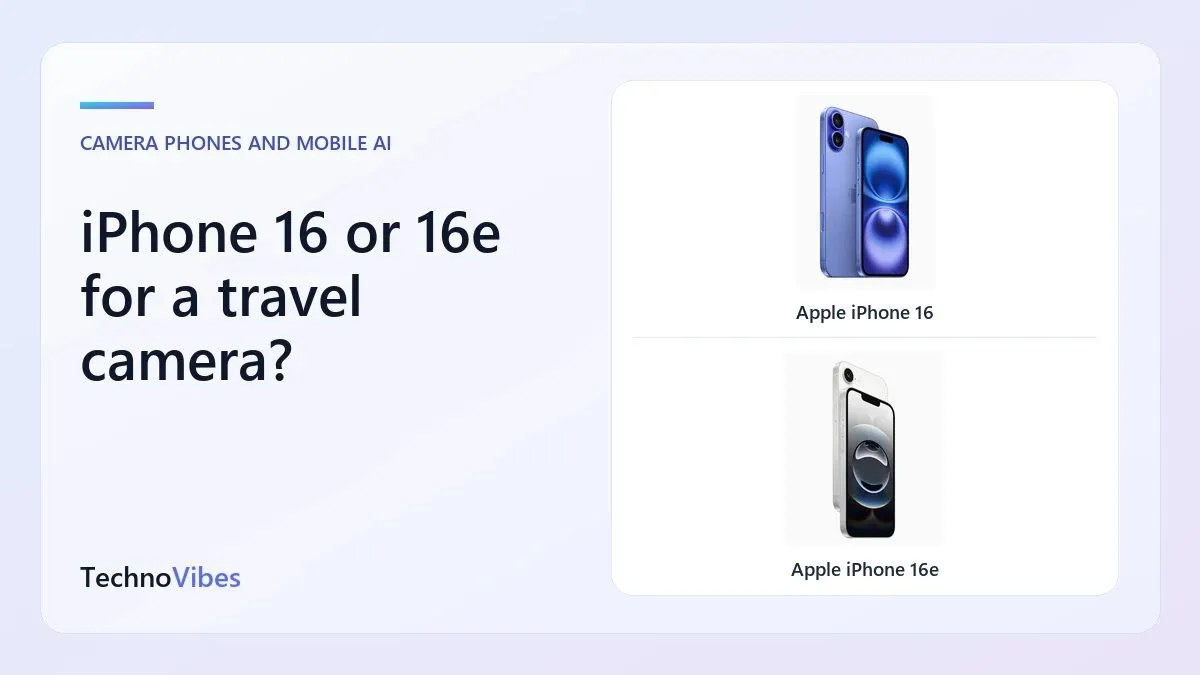
If your phone is also your travel camera, the choice between the iPhone 16 and iPhone 16e comes down to one lens. Both share the A18 chip and a 48MP main camera with a 2x crop, and both are rated IP68. The iPhone 16 adds a 12MP ultrawide camera and the Camera Control button. The iPhone 16e counters with longer rated battery life and a lower price.
Quick answer
- iPhone 16 if you photograph landscapes, monuments, hotel rooms, narrow streets or big groups.
- iPhone 16e if you mostly photograph people and food, and battery life on long travel days matters more.
Key specifications compared
| Feature | iPhone 16 | iPhone 16e |
|---|---|---|
| Rear cameras | 48MP Fusion + 12MP ultrawide (120°) | 48MP main (2x crop) |
| Macro | Yes, via ultrawide | No |
| Camera Control | Yes | No |
| Action button | Yes | Yes |
| Video playback (Apple rating) | Up to 22 hours | Up to 26 hours |
| Weight | 170g | 167g |
| Wireless charging | MagSafe | Qi (MagSafe not listed) |
| Water resistance | IP68, 6 metres for 30 minutes (both) |
Specifications from Apple's India specification and support pages.
Why the ultrawide matters on a trip
Monuments and landscapes
Standing in front of the Gateway of India, inside a Rajasthan fort courtyard or on a Himalayan viewpoint, you often cannot step back far enough to fit everything in at 1x. A 120-degree ultrawide gets the whole scene. With the iPhone 16e, you would need to take a panorama, which does not work well with moving people.
Small rooms and narrow lanes
Homestays, houseboats and old city lanes are tight spaces. The ultrawide lets you capture the full room or street. This is also useful if you write travel reviews or share stays with friends.
Close-ups
The iPhone 16 uses its ultrawide for macro shots of food, flowers and textiles. The 16e cannot focus as closely, so tiny details need to be shot from further away and cropped.
When the iPhone 16e is the smarter travel choice
Apple rates the 16e at up to 26 hours of video playback compared with 22 hours for the iPhone 16. On long travel days with maps, bookings and photos, that extra endurance reduces how often you hunt for a charging point. If your travel photos are mostly selfies, people and food at 1x or 2x, you will not miss the ultrawide much, and the savings can pay for a power bank or extra storage.
The products
Apple iPhone 16
- Strengths: ultrawide and macro, Camera Control for quick shots, MagSafe accessories.
- Limits: higher price, slightly shorter rated battery life.
Check iPhone 16 price on Amazon India
Apple iPhone 16e
- Strengths: longest rated battery life here, same A18 chip, IP68, lower price.
- Limits: single rear camera, no Camera Control, no MagSafe listed.
Check iPhone 16e price on Amazon India
Travel buying checklist
- Pick enough storage. 4K travel video fills 128GB quickly; consider 256GB if you will not back up during the trip.
- Plan charging. Neither phone includes a charger. Pack a USB-C charger and cable.
- Check the seller. Buy from an authorised seller with a GST invoice for Apple warranty.
- Add a case with lanyard if you shoot near water or from boats.
Frequently asked questions
Can I add a clip-on wide-angle lens to the iPhone 16e?
You can, but clip-on lenses usually reduce sharpness and are inconvenient. If you want wide shots regularly, the iPhone 16 is the better buy.
Is 2x zoom on both phones the same?
Both crop the centre of the 48MP sensor for 2x, so results are similar.
Which is better for travel vlogging?
The iPhone 16, because the ultrawide gives you more framing options when holding the phone at arm's length.
A sample travel day with each phone
Imagine a day in Udaipur. You start with sunrise over Lake Pichola, move to the City Palace courtyards, eat lunch at a rooftop café and end with an evening boat ride. With the iPhone 16, you switch to the ultrawide for the lake panorama and the palace courtyards, use the main camera for portraits on the rooftop and shoot macro details of mirror work and miniature paintings. With the iPhone 16e, the palace courtyards and lake views need panoramas or several frames, but portraits and food look just as good, and you are less likely to be hunting for a socket by the evening boat ride.
If that day sounds like your kind of trip, think about which half you would miss more: the wide shots or the extra battery headroom. Most people who travel for architecture and landscapes choose the iPhone 16; most people who travel to visit family choose the 16e and pocket the difference.
Accessories worth packing
- A 20W or faster USB-C charger, since neither phone includes one.
- A compact power bank for long days of maps and photos.
- A case with raised camera edges to protect the lenses on rough surfaces.


