

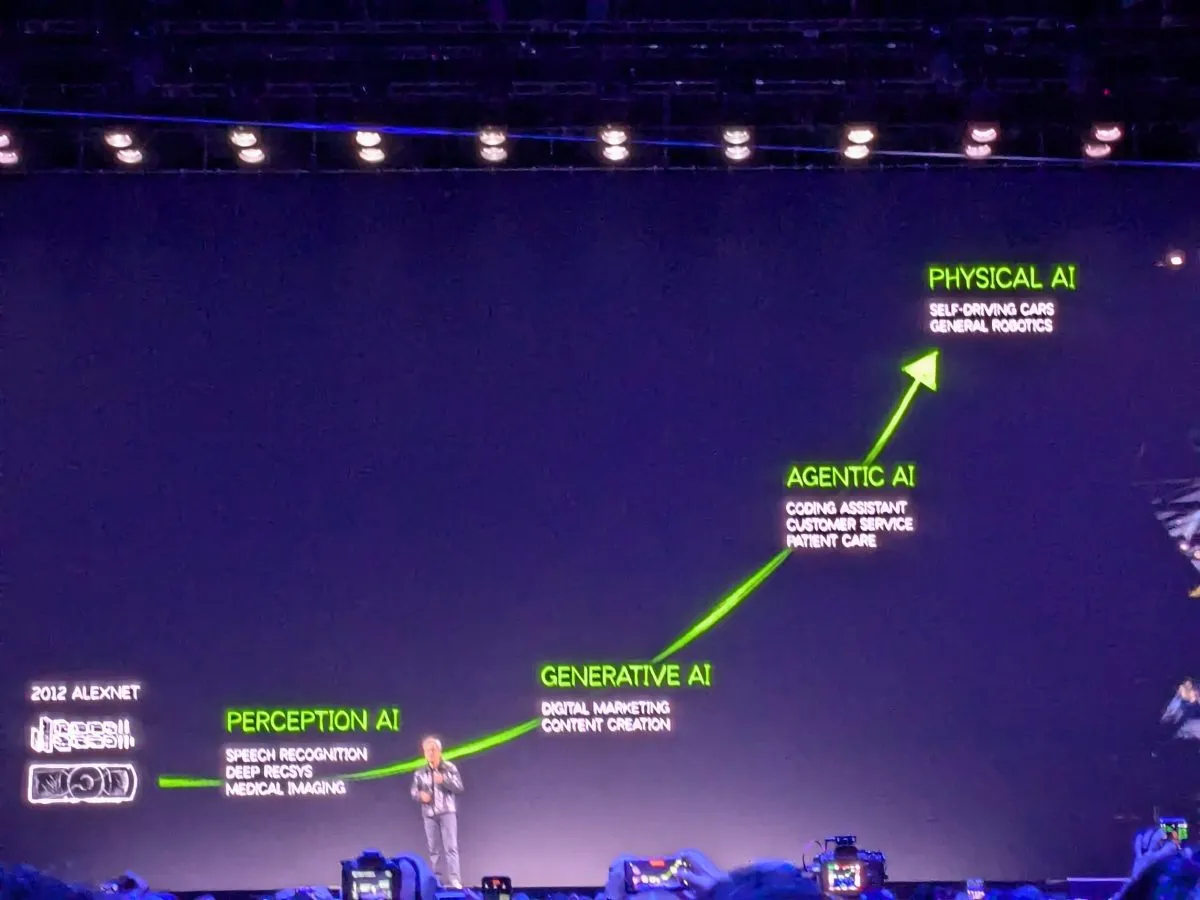
Jensen Huang's return to Nvidia sent a wave of buying through the wider artificial intelligence trade on 23 November 2026. Reuters reported gains across major technology companies, semiconductor shares and businesses supplying AI computing capacity. The reaction made the leadership story a market-wide event, with investors reassessing companies connected to the same infrastructure expansion. Read Reuters' closing report.
For readers in India on 24 November, the central question is why one company's management announcement should move such a broad group. The answer involves shared expectations: equipment suppliers, cloud operators, infrastructure developers and software customers can all be exposed to the pace of AI investment, although their business models and financial risks differ.
The rally reached beyond one stock
Reuters described semiconductor and technology indexes rising sharply alongside companies including Amazon, Microsoft, Meta and Alphabet. It also reported renewed buying in neocloud and data-centre companies. Those observations establish the breadth of the response without requiring every business in the group to have announced new earnings or a new customer contract that day.
For a separate view of the completed session, ABC's 24 November market coverage summarised Wall Street's gains at approximately 6.5% for the Nasdaq, 4.7% for the S&P 500 and 3% for the Dow. These rounded figures describe the US rebound, rather than current Indian index performance.
The distinction matters because a broad rally is not the same as an identical rally. Different indexes hold different companies and apply different methods. Even when all rise, their movements cannot be substituted for one another. A technology-heavy benchmark can respond more strongly than a benchmark with more exposure to unrelated industries.
Follow the chain from a chip to an AI service
A simple hypothetical project helps explain the links. A cloud operator buys computing equipment, installs it in a facility and offers customers access to that capacity. The project also needs networking, power, cooling, storage and staff. The operator's customers then need applications that generate enough value to justify paying for the service.
At each stage, a different company may earn revenue and incur costs. A chip supplier receives payment for equipment. An infrastructure operator must recover the expense of installing and running it. A software company must turn access to computing into a service people will use. These related activities are not interchangeable businesses, even when the stock market groups them under one AI label.
A leadership announcement can influence the expected stability of that chain. If investors believe an important supplier will communicate and execute more consistently, they may also become more comfortable with businesses depending on its equipment. This is our analysis of a possible confidence channel. It does not establish that Nvidia's customers signed additional contracts because Huang returned.
Why software compatibility adds another connection
Nvidia's relevance extends to the tools used to run workloads. Its CUDA Programming Guide describes how developers use its platform to execute work on GPUs. That technical relationship creates a connection between computing hardware and the applications built to use it.
Imagine a research team that has tested its software on a particular configuration. Moving to another setup may involve checking correctness, measuring performance and revising deployment procedures. The relevant cost includes people and time, alongside equipment. This example illustrates why purchasing decisions often consider an ecosystem rather than a component's headline specifications alone.
For the market, those relationships can make a supplier's strategic continuity feel significant. For an engineering team, the practical evidence is different: supported software, reliable documentation and measured results on its own workload. A stock-market reaction cannot substitute for that technical evaluation.
Why equipment growth and customer profitability can diverge
A supplier can report strong sales before its customers have recovered the cost of their infrastructure. There is no contradiction in that sequence. The supplier's transaction may be completed when equipment is delivered under the relevant terms, while the buyer expects to earn revenue over years of operation.
Consider an illustrative operator spending $100 million on a facility and its equipment. Its eventual return would depend on utilisation, service pricing, running costs and the useful life of the assets. If the equipment is busy at attractive prices, the project may perform well. If capacity sits idle or prices fall, the same initial purchase can produce a weaker outcome for the buyer.
These figures are a teaching example, not a description of Nvidia or any named customer. Their purpose is to show why a supplier's growth rate and a customer's investment return answer different questions. A broad stock rally may express renewed optimism about both, but subsequent financial evidence must be assessed separately.
Debt adds a further layer to the AI trade
Reuters' intraday market report placed the rebound against concerns about borrowing supporting AI investment and the returns that spending might produce. That background helps explain why a confidence shock can spread among companies with otherwise different operations.
In a hypothetical debt-funded project, interest and principal obligations remain even if equipment is used less than expected. A business with the same technology but a different financing structure may therefore have a different risk profile. It is useful to distinguish technical demand, customer revenue and financing terms instead of treating them as one question.
This is also why a rally does not prove that funding concerns have been resolved. A rising share price may improve sentiment toward a borrower, but it does not automatically change an existing repayment schedule or cancel an interest expense. Those changes would require specific financial actions.
How the story travels across markets
International investors follow the same large companies, and businesses in different countries can serve the same customers. That creates channels through which US news can influence the next trading day elsewhere. However, local currencies, domestic demand and country-specific news can also affect share prices.
For Indian readers, the reasonable conclusion is that Nvidia's announcement became relevant to global technology sentiment. It would go further than the evidence to claim that every Indian IT or semiconductor-related company benefited directly. A company's actual revenue exposure and contracts must be checked before attaching a global market headline to its business outlook.
The same care applies to funds. A fund's name may mention technology or AI while its holdings differ materially from another fund with a similar label. Exposure depends on the actual portfolio. A US benchmark's percentage gain is not automatically the return earned by an Indian fund, especially after considering currency movements and the time at which its value is calculated.
What to watch after the relief rally
The most useful follow-up is to look for evidence along the chain: equipment deliveries, deployed capacity, paying customers and the cash generated by services. A project can progress on one measure while remaining uncertain on another. Reporting those milestones separately is more informative than assuming that the entire sector moves through one shared stage.
Monday's rally demonstrated that Nvidia's leadership is closely connected to investor confidence in the wider AI expansion. Whether that confidence is sustained will depend on many companies doing their own work successfully. Huang's return changed the market's immediate mood; the economics of building and using AI infrastructure will determine what follows.
Jensen Huang at CES in Las Vegas on 6 January 2025. Archival photograph; not his November 2026 return. Photo: Pronoia / Wikimedia Commons. CC0 1.0. No local edits. Commons-provided JPEG downloaded unchanged.


