

Nvidia shares surged 31.48% to close at $165.05 on Monday, 23 November 2026, after Jensen Huang's reinstatement as chief executive transformed sentiment around the chipmaker. The stock gained $39.52 in the regular US session, according to Yahoo Finance's dated closing quote. For Indian readers on 24 November, those are completed Monday trading figures.
The rally was a forceful response to a leadership announcement, but its meaning needs careful unpacking. A large percentage gain can recover a substantial amount of market value while leaving a stock below an earlier peak. It can also reflect a change in confidence without producing an immediate change in the company's revenue, cash balance or product shipments.
The closing numbers, explained
Using the reported close and dollar change, the previous regular-session closing price works out to $125.53: $165.05 minus $39.52. Dividing the $39.52 gain by that earlier price gives approximately 31.48%. These are simple calculations from the quoted figures, rather than a separate estimate of Nvidia's business performance.
| Measure | 23 November session |
|---|---|
| Previous close, calculated | $125.53 |
| Regular-session close | $165.05 |
| Dollar increase | $39.52 |
| Percentage increase | 31.48% |
Why does the denominator matter? Imagine a share rising by $10. If it began at $20, that is a 50% gain. If it began at $200, it is a 5% gain. Percentage changes describe movement relative to a starting point; they do not measure the absolute size of a business or tell us how much a particular investor has earned.
Why Huang's return moved the price
Reuters' report on Monday's rally linked the jump in Nvidia and other AI shares to Huang's return. The leadership reversal gave investors a concrete new development around which to reassess expectations. The report also placed the rebound against the preceding selloff in technology stocks.
One way to understand the reaction is through uncertainty. When investors cannot confidently judge who will lead a company or how its strategy will be communicated, they may demand a lower price to accept that uncertainty. A confirmed appointment can change that judgment quickly. This is an explanation of how markets can react, not a calculation of the precise portion of Monday's move attributable to any one factor.
Investors can also react to what they expect other investors to do. Someone who believes a news event will bring buyers back may trade before new financial results appear. That makes a stock price a continuously changing assessment of expectations, positioning and available information. It is not a direct meter of factories producing more equipment minute by minute.
A rebound is measured from the lower base
Earlier losses and subsequent gains use different starting prices. A hypothetical stock that falls from $100 to $70 loses 30%. If it then gains 30%, it reaches $91. A full recovery would require an increase of about 42.86% from $70. This arithmetic is why two equally large percentage moves in opposite directions do not cancel each other.
For Nvidia, Associated Press reported the $165.05 close alongside an earlier all-time high of $239.24. Using those reported prices, Monday's close was approximately 31.01% below that high. Reaching $239.24 from $165.05 would require a further increase of roughly 44.95%. These calculations describe the gap; they are not price targets.
A reader who bought at a different price would have a different experience. Someone entering near Friday's close could see a very large one-session gain. Someone who bought near the earlier peak could still be below their purchase price. Headlines about a company's rebound therefore cannot describe every shareholder's result.
Why market value is different from cash raised
Market capitalisation is broadly the share price multiplied by the number of outstanding shares. In a simplified example with one billion shares, a $10 price increase raises market value by $10 billion. That does not mean $10 billion has been deposited in the company's bank account. It means the market is valuing the existing shares more highly.
The distinction is useful when reading reports that a very large company added hundreds of billions of dollars in value. A relatively small percentage change can produce an enormous valuation movement when applied to a large share base. The figure measures the changed market valuation, not the amount of stock traded or new money raised by issuing shares.
For that reason, this article does not treat a valuation rebound as financing for a new factory or a new customer order. Those developments would require separate evidence. A higher share price may affect corporate opportunities, but an effect on opportunities is different from an announced transaction.
Intraday headlines and closing prices answer different questions
During a volatile session, several accurate headlines can show different gains. One may describe the opening reaction, another a mid-session high, and another the final regular-session close. A price can move between all three. Comparing them without their timestamps can create a false impression that the reports contradict one another.
Our reference point here is the completed $165.05 regular-session close. An overnight quote, premarket quote or after-hours quote is a different observation. It should be identified by session and time before it is compared with the previous close. A screenshot stripped of those labels can easily exaggerate or obscure the movement.
Nasdaq lists regular market hours as 9:30 a.m. to 4 p.m. Eastern time. On 23 November, the 4 p.m. New York close corresponds to 2:30 a.m. IST on 24 November. The conversion explains why India's morning coverage discusses a US trading session dated the previous day.
What would support a lasting recovery?
The next meaningful evidence will include business execution and disclosures, alongside price movements. Investors can examine whether customers continue their projects, whether the company delivers what it has announced, and whether reported financial results support expectations. None of those questions can be settled by extrapolating a single day's percentage gain into the next month.
A useful reading habit is to keep three columns: confirmed events, reported market prices, and interpretation. Huang's reinstatement belongs in the first. Monday's closing price belongs in the second. Claims about why the recovery will continue belong in the third unless supported by further evidence. This approach preserves the significance of the rally while making clear what remains uncertain.
For today, the news is substantial enough on its own: Nvidia recorded a dramatic regular-session rebound after its co-founder returned to the CEO role. The correct closing figures show the scale of that response. The arithmetic also shows why a sharp comeback and an unfinished recovery can exist at the same time.
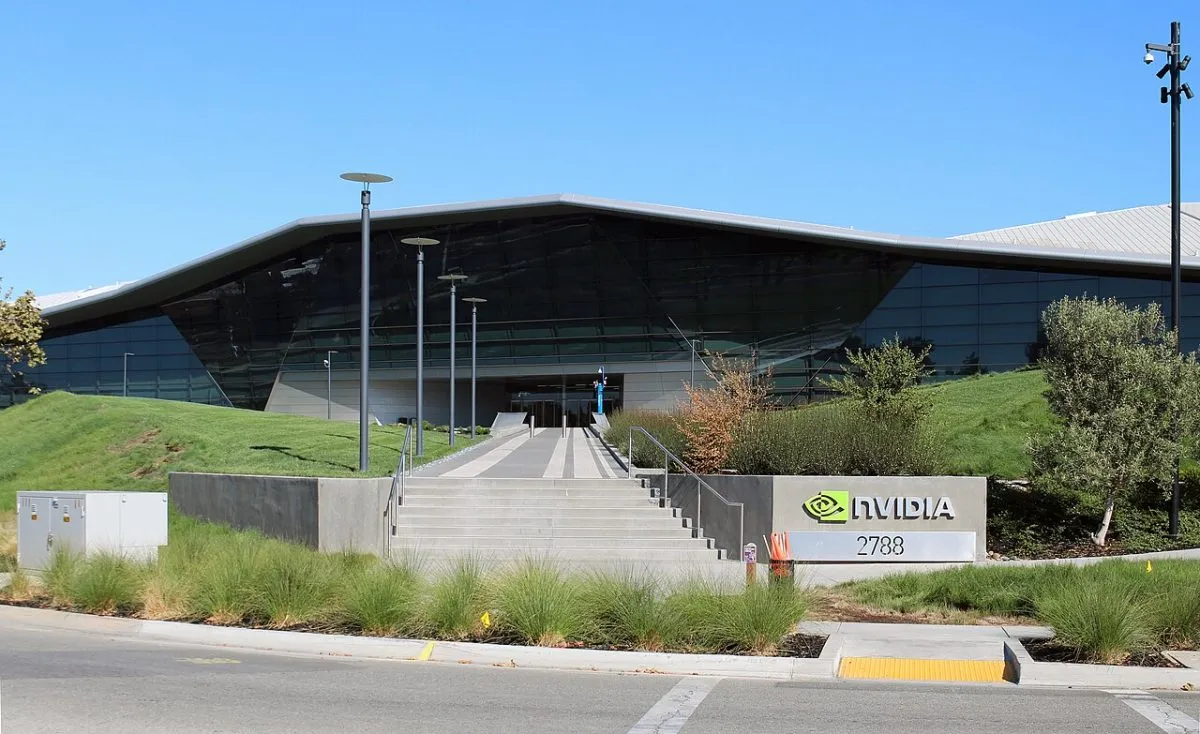
Nvidia headquarters in Santa Clara, California, photographed on 4 August 2018. Archival photograph. Photo: Coolcaesar; Commons perspective and crop revision by Jacek Halicki / Wikimedia Commons. CC BY-SA 4.0. Commons-generated 1280-pixel proportional resize; no local edits. Commons revision already includes perspective correction and cropping by Jacek Halicki (2020). This photo remains CC BY-SA 4.0.


