

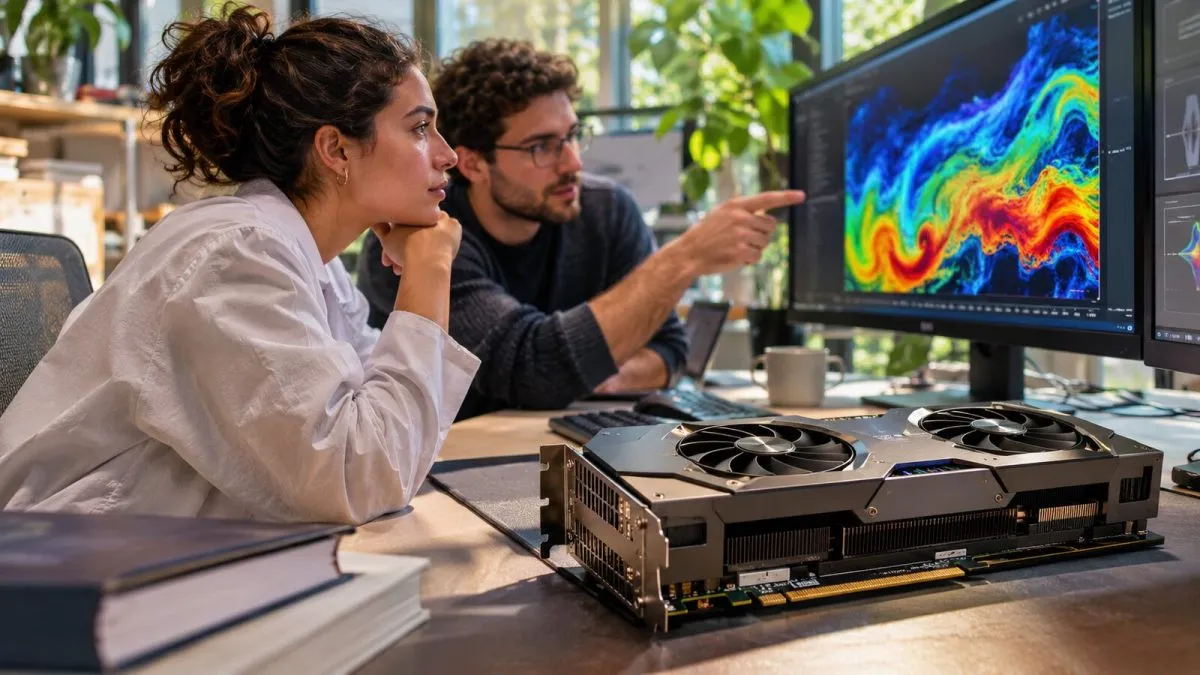
NVIDIA introduced Rubin HPC at SC26 on November 16 as a GPU aimed at science, engineering and analytics. The company described more than 50,000 CUDA cores, sparse-data acceleration and seventh-generation NVLink connectivity. The announced availability horizon is 2028, so this is a roadmap story rather than a product readers can assume is shipping today.
Why scientific computing needs a different lens
Scientific applications often combine simulation, data processing and AI. Their requirements can differ from those of a chatbot service. Numerical precision, data movement and the behavior of a particular solver may matter more than a headline figure for low-precision AI arithmetic.
NVIDIA positions Rubin HPC within the Vera Rubin platform. Its performance descriptions are vendor claims about the announced design, not results from our own hardware testing.
What the architecture could change
More computing resources can help only when software keeps them usefully occupied. A workload may be limited by moving sparse data, communicating between GPUs or preparing inputs on CPUs. The emphasis on data movement and interconnects reflects those system-level constraints.
For a university lab, a faster accelerator can also change how many experiments fit within an allocation. That benefit still depends on queueing, software compatibility and how the application scales. Doubling theoretical throughput does not necessarily halve the time required for a complete research project.
How researchers can prepare
Profile existing applications before planning a purchase. Identify whether a representative job is limited by computation, memory capacity, storage or communication. Preserve validated numerical reference results so a future port can be checked for correctness as well as speed.
Procurement teams should treat 2028 as the company's announced expectation and monitor updates. Budget decisions need actual system specifications, software support and delivery terms when those become available. Rubin HPC is a useful indication of NVIDIA's scientific-computing direction, but its eventual value will be measured on real applications.
Sources and related reading
Source: NVIDIA Blog, published 16 November 2026.
Related on TechnoVibes:
More coverage: Laptops & PCs.
Image: AI-generated editorial illustration. It depicts a representative scene, not a photograph of the reported event or an exact product reference.


